
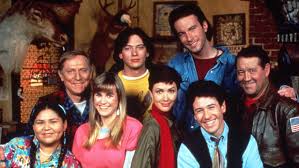
I wrote this post in January 2019, in the Beforetimes. At the time Northern Exposure was not available by streaming apparently because of music rights issues. Which was a shame because it’s still an amazing show. I just found out it’s now on Amazon Prime. Go watch it. Right now! OK, if you need more convincing, I’m dusting off this puppy and reposting. Enjoy!
I was a big fan of Northern Exposure (1990-1995). My all-time favorite episode centers on main character half-Native Alaskan Ed and his insecurity — which is embodied in a little green man representing Low Self-Esteem, who lives with different types of other personal demons in a makeshift camp. He shows up unexpectedly to sabotage Ed when he tries to ask a girl out or help a patient in his apprentice shaman practice. In another episode, Ed goes back to the camp to fight his patient’s demon, External Validation. Of course, that demon lives in a fancy trailer, has an expensive car, and is dressed like a GQ model. I always the loved the idea of reducing your insecurities, which sometimes seem like big intractable monsters, to an annoying person you can laugh at and who lives with a lot of other dysfunctional, annoying people in a camp. You wouldn’t let that person have power over you, would you?
When I realized the show aired nearly 30 years ago, (WTF?), I thought I should try to rewatch the episode to make sure I remembered it correctly. I mean incorrectly recalling it could never happen, right?
Not only was the episode as I remembered, it was even better — great writing, interesting and quirky characters, and tackling themes that are still relevant, which is kinda cool and kinda depressing. This shit is still not fixed, people.
The premise is that a new doctor Joel Fleischman from NYC needs to work for 3 years in a rural area to forgive his medical school loans. He gets assigned to the tiny Alaskan town of Cicely. But this show became so much more than its “fish out of water” premise. I had too much fun watching to take a lot of notes on all the great moments, so here are a few highlights that reminded me fiction can be an excellent place to work out some of these tough topics.
Chris and Bernard Stevens
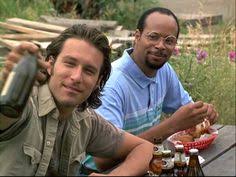
The episodes featuring white philosopher-DJ Chris and his Black half-brother Bernard (pictured above) are really good. They meet by accident and are so alike in so many ways, which mystifies them because they grew up in two different families, in two separate states. They share a birthday and only saw their dad every other year on their birthday. Turns out their dad was a traveling salesman who had 2 different families. In a stereotype buster, Chris’s family is completely dysfunctional and he spent time in jail for theft, while Bernard’s family was functional middle class, and he is an accountant.
The Bernard and Chris episodes tackle a number of aspects of racism, but my favorite was when Chris lost his voice, sort of a career killer for a DJ. Maurice owns the station, is the town’s founder, local blowhard, bigot, and is always scheming how to get his town on the map. Before he even knows if Chris’s voice will return, he asks Bernard if he would consider replacing his brother — they have a similar speaking style and philosophical musings. Bernard calmly tells Maurice he is a racist and a bigot, and enumerates many examples of Maurice’s dismissive and insulting behavior. He also calls Maurice out for not even waiting to see if Chris will get better. Bernard pauses and lets Maurice sweat a bit and shift uncomfortably. Then Bernard says, “But yeah, I’ll consider your offer.” Chris gets better.
Maggie O’Connell and Jane Harris

In another episode, Maggie the bush pilot has an argument with the new teacher, Jane (pictured above), a former military aerial tanker pilot, who says women shouldn’t fly in combat. Maggie, an unapologetic feminist is incensed that another woman — especially a fellow pilot — could say women don’t have the emotional fortitude to fly combat. They have several rounds of very heated discussions, with neither giving an inch. Finally, Maggie realizes that just because they are both women doesn’t mean they will agree on everything. She decides to apologize, and they agree to disagree. What a concept. Could we have more of that please? You know, anytime one of the 51% of white women who voted for Trump want to apologize, I’ll do my best to accept it.
Adam, Town Hermit
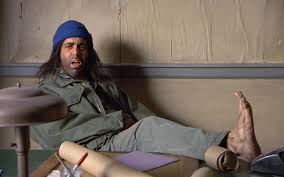
Adam (pictured above), a recurring character, is a barefoot paranoid curmudgeon hermit, who is also a classically trained chef, and may or may not be a pathological liar. Because his character is so on the social fringe, he gets to make a lot of social commentary. A stand out episode that caught my attentions talks about entitlement. He points out that the constitution does not say we’re entitled to be happy; we’re only guaranteed the pursuit of happiness. Which, of course, in our country most often applies to the white people, who are also often the most confused about this, thinking they are actually entitled to happiness. Go unpack that, and I’ll meet you back here in a couple of months.
Maurice Minnifield
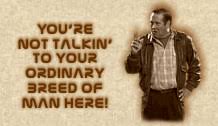
And then there was this scene, which sucker-punched me. Chris is afraid of needles, but Maurice (pictured above) ignores it and forces him to give blood during the annual drive because he bet $1,000 that Cicely would collect more blood than the rival, neighboring town. He’d lost the bet the previous year and was humiliated at the annual Tundra Sons Lunch (Think Alaskan male version of the Daughters of the American Revolution). Maurice, a driven ex-astronaut, is the pinnacle of a successful businessman, and he sputters with all of the outrage of a privileged white man obsessed with winning, “If they [the rival town] pledge 500 pints, we’ll do 501. Then we’ll see who’s smiling at the Tundra’s Son Lunch!”
To which Chris responds, deadpan: “And we wonder what makes America so great, huh?”
Yeah. That.
P.S. A teacher found my original post and asked me which episodes Ed and his demons were in — she thought it would be a great way to help kids see their learning issues in a different way. So if you are interested: The Green Man (Ed’s personal demon) appears in 2 episodes. “Heal Thyself,” season 5, episode 8, and “Grand Prix,” season 5, episode 22. The camp of personal demons appears in “Grand Prix”.
 sandradeden.com